Introduction
Microsoft 365 Copilot feels different from traditional AI assistants—and that difference isn’t accidental. Behind Copilot sits Work IQ, a purpose-built intelligence layer designed to understand how work actually happens across people, teams, and organizations.
For Microsoft 365 architects, developers, and MVPs, Work IQ represents a major architectural shift: Microsoft is no longer building AI as isolated features, but as a shared intelligence fabric that spans apps, agents, and workflows.
In this post, we’ll break down Work IQ’s architecture, where it fits in Microsoft’s AI stack, and why it fundamentally changes how enterprise AI should be designed.
Why AI Architecture Matters in the Workplace
Most AI copilots today rely on:
- Prompt engineering
- Document retrieval (RAG)
- App-specific context
While effective for simple scenarios, these approaches fail at scale because:
- They lack continuity
- They don’t understand relationships
- They treat work as documents, not workflows
Microsoft recognized that work is not content—it’s signals, patterns, and collaboration.
Work IQ was built to model this reality.
Where Work IQ Sits in the Microsoft AI Stack
Work IQ is not a UI, not an app, and not a standalone service.
It sits between:
- The Copilot experience
- And the organizational work signals that define how work happens
Conceptual Placement
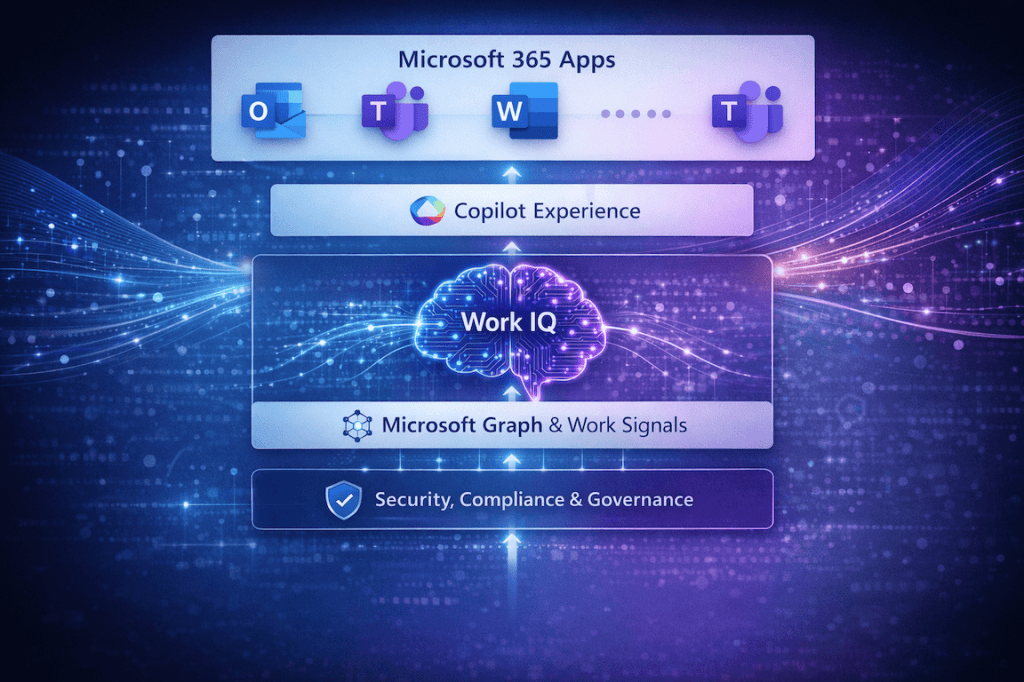
This positioning allows Work IQ to act as a shared intelligence layer across:
- Copilot
- Custom AI agents
- Future AI-powered Microsoft 365 experiences
The Work IQ Ecosystem
Work IQ doesn’t operate alone. It works as part of a broader Microsoft ecosystem:
- Microsoft Graph – Provides work signals and relationships
- Microsoft 365 Copilot – Delivers the user experience
- Copilot Studio – Enables custom agent creation
- AI Agents – Role- and task-specific intelligence
- Microsoft Fabric / Foundry – Organizational data intelligence (adjacent)
Work IQ standardizes intelligence so every Copilot and agent doesn’t need to reinvent context.
Deep Dive: The Three Layers of Work IQ (Architect View)
🔹 1. Data Layer – Understanding Work Signals
The data layer aggregates permission-aware signals, not raw documents.
Examples:
- Emails, meetings, chats
- Document collaboration patterns
- Task ownership and timelines
- Informal team relationships
This goes far beyond traditional search:
Work IQ understands how information is used, not just where it exists.
🔹 2. Memory Layer – Learning How People Work
Work IQ introduces persistent work memory.
This includes:
- Personal communication style
- Recurring workflows
- Frequently collaborated teammates
- Role-based priorities
For architects, this is critical:
- Memory is scoped
- Governed
- Aligned with Microsoft 365 permissions
This enables Copilot to improve over time, without manual retraining or prompts.
🔹 3. Inference Layer – Reasoning Across Work
Inference is where Work IQ becomes transformational.
It enables:
- Cross-app reasoning
- Pattern recognition
- Next-best-action suggestions
- Proactive insights
Example:
Copilot can infer that a document, meeting, and email thread belong to the same initiative—even if never explicitly linked.
This is work intelligence, not content intelligence.
How Work IQ Powers AI Agents
One of the biggest Ignite announcements was that Work IQ also powers AI agents.
Why This Matters
Without Work IQ:
- Every agent needs custom context logic
- Security must be reimplemented
- Organizational understanding is shallow
With Work IQ:
- Agents share the same intelligence layer
- Context is consistent across Copilot and agents
- Governance is inherited automatically
This makes Copilot Studio far more powerful for enterprises and ISVs.
Work IQ vs Custom RAG (Architect Comparison)
| Custom RAG | Work IQ |
|---|---|
| Document-centric | Work-centric |
| Stateless | Memory-driven |
| Prompt-heavy | Inference-led |
| App-specific | Cross-app intelligence |
| Developer-managed | Platform-managed |
RAG is still useful—but Work IQ operates at a higher abstraction level, closer to how humans work.
Why Work IQ Matters for M365 Architects & MVPs
Work IQ changes how we should design solutions:
- Less custom AI plumbing
- Built-in compliance and governance
- Faster agent development
- More consistent user experience
It also signals where Microsoft is heading:
AI-first architecture will be intelligence-led, not app-led.
What This Means Going Forward
Work IQ is foundational. As Microsoft expands Copilot and agents, this intelligence layer will:
- Become more transparent
- Become more extensible
- Influence how enterprise AI solutions are evaluated
For MVPs, understanding Work IQ now puts you ahead of the curve.
What’s Next in This Series
In the next post, we’ll explore:
Work IQ + Copilot Studio: Building Intelligent AI Agents Without Reinventing Context
Happy Sharing…
 Knowledge Share